
Indoor Vertical Farming
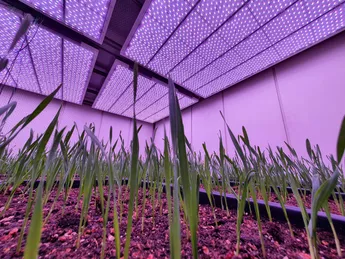
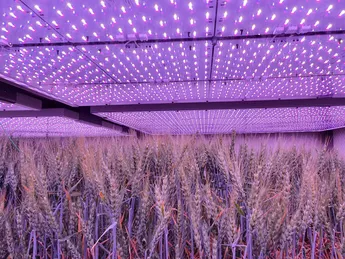
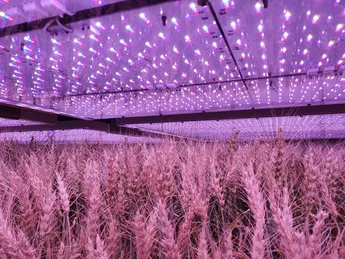
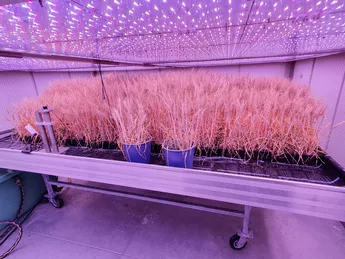
In dem Forschungsbereich des Vertical Farmings versuchen wir, unsere Modellierungsfähigkeiten aus Freilandanlagen in Innenanlagen einzubringen. Unter kontrollierten Bedingungen können wir sehr detailliert bestimmen, welche Faktoren das Wachstum der Pflanzen beeinflussen. Die Idee des vertikalen Anbaus beruht auf der Idee, Land und Input-Ressourcen wie Wasser oder Dünger zu sparen und an die spezifischen Bedürfnisse einer Pflanze anzupassen. Darüber hinaus reduziert ein hoher Grad an Mechanisierung, zum Beispiel durch vollautomatischen Transport der Pflanzen innerhalb der Räume sowie Beleuchtungs- und Bewässerungssysteme, den Aufwand für den Betreiber auf ein Minimum. In dem geschlossenen, von der Außenwelt abgeschirmten System kann der Wasserverbrauch um bis zu 90 Prozent reduziert werden und auf chemischen Pflanzenschutz kann im Idealfall ganz verzichtet werden. Der Ertrag kann durch optimale Versorgungs- und Wachstumsbedingungen um ein Vielfaches gesteigert werden.
In den Vertical-Farming-Kammern in der Station Dürnast auf dem Campus der TUM-Weihenstephan werden Versuche mit Weizen und Sojabohnen durchgeführt. Darüber hinaus ist Professor Asseng einer der TUM-Hauptverantwortlichen des Proteins4Singapore-Projekts (Link zur Beschreibung der Projektseite, sobald diese fertiggestellt ist), in dem er ein Pilotexperiment für eine vertikale Sojafarm in Singapur durchführt.
What Is the Limit of Vertical Farming Productivity?
With the possibility of co-optimizing all growth factors in vertical farming, such systems could contribute to future food supply, but the potential productivity is unknown. Analyzing 171 publications with 1403 data points across 10 crop categories from controlled-environment experiments revealed major productivity variation among and within crop species. Potato produced the most edible dry mass of 33 g m−2 day−1, 28 times more per layer than open-field cultivation. High planting density crops generally showed a high productivity, while crops with longer life cycles were less productive considering time and space. The limits of productivity, defined as the points at which optimizing growth factors return no further benefit, remain uncertain. Uncovering this limit requires systematic, standardized, and scalable controlled-environment experiments across crop types. https://doi.org/10.1002/fes3.70061

The future potential of controlled environment agriculture
The production of high-quality food needs to increase to feed the growing global population. Controlled environment agriculture (CEA) systems in a vertical farm setting—in which several layers are stacked above each other, thus increasing the area for growth—can substantially boost productivity for crops, algae, mushrooms, fish, insects, and cultured meat. These systems are independent of climate, weather, and region, offering reduced environmental impact, although they come with high energy demands. An easy-to-understand, quantitative performance assessment of the theoretical potential for these 6 CEA systems is proposed here. It compares them against the world's main food production system: field production of maize, wheat, rice, and soybean. CEA could play a pivotal role in the global food supply if efficiencies in energy, control of growth environments, and waste stream utilization are vastly improved. Technological advancements, targeted policy support and public engagement strategies will be necessary to significantly reduce production costs and increase public acceptance. https://doi.org/10.1093/pnasnexus/pgaf078
