
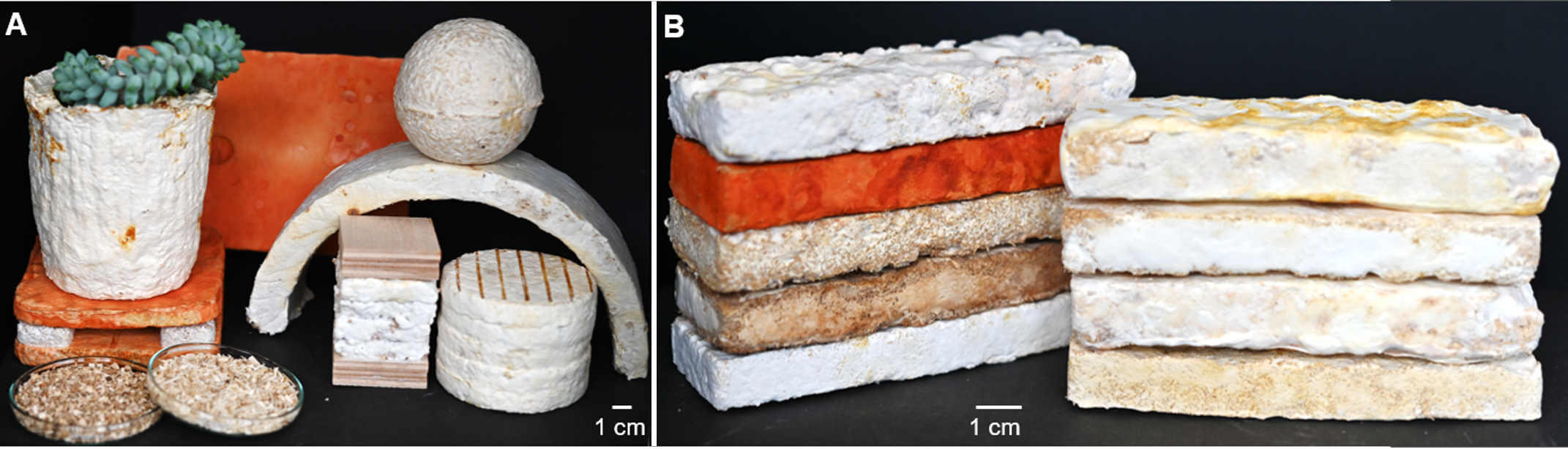

At the end of November, the German Research Foundation (DFG) approved nine new Collaborative Research Centres (SFB) to further strengthen cutting-edge research at German universities. Among them was SFB1743 "MY-CO BUILD", which aims to develop mycelium-based building materials and will receive a total of around 10.3 million euros in funding over the coming years. In addition to the coordinating university TU Berlin (Prof. Vera Meyer), TUM is also playing a key role in this network with the professorships of J. Philipp Benz and Heiko Briesen.
MY-CO BUILD in short
The SFB "MY-CO BUILD: Biotechnological production, characterisation and sustainability assessment of fungus-based building materials" aims to develop a new class of building materials in which fungal mycelium from renewable raw materials from agriculture and forestry forms stable, lightweight and well-insulating composite materials. These materials do not require additional binding agents, are biodegradable and contribute to a climate-friendly, bio-based circular economy in the construction sector.
Contribution of TUM
The Chair of Fungal Biotechnology in Wood Science (Prof. J. Philipp Benz) contributes its expertise in fungal degradation and conversion processes of wood and biomass substrates to the development of mycelium-based materials. The Chair of Systems Process Engineering (Prof. Heiko Briesen) contributes to the optimal design of the production, scaling and evaluation of the new materials using µCT-based imaging of the fungal substrate interaction and model-based process and system analyses.
Integration into a strong network
Besides TU Berlin and TUM, MY-CO BUILD brings together partners from the Karlsruhe Institute of Technology (KIT), the Bochum University of Applied Sciences, the Leibniz Institute for Agricultural Engineering and Bioeconomy (ATB) in Potsdam and Aalborg University (Denmark). Together, the consortium is laying the scientific foundations for establishing fungi as sustainable "builders" for future construction and housing concepts.